
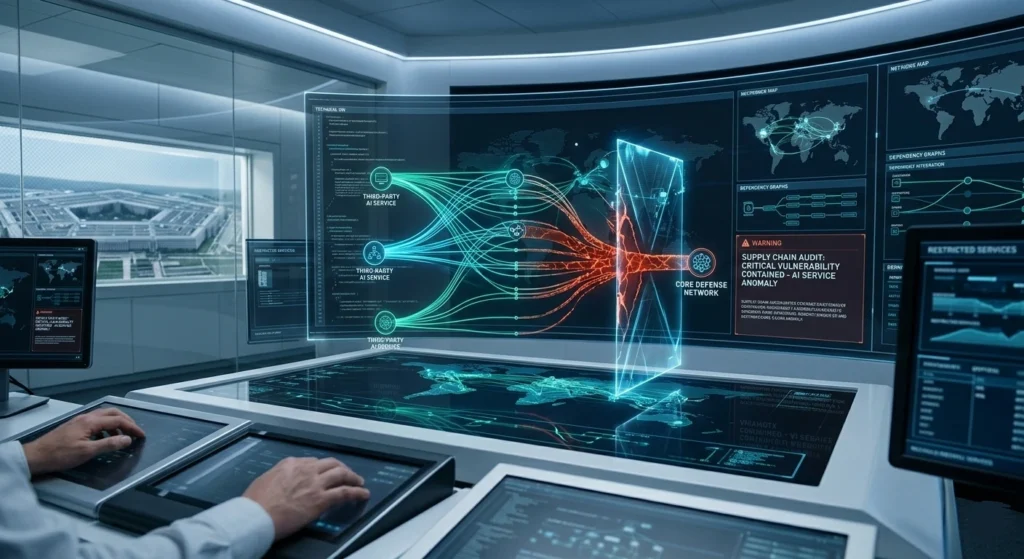
The Pentagon Anthropic Supply Chain Risk designation marks a historic clash between AI ethics and military power
The United States Department of Defense has taken a drastic step against one of the most prominent artificial intelligence companies in the world. On Thursday, officials confirmed that the military formally designated Anthropic as a Pentagon Anthropic supply chain risk. This move effectively limits how the government and its contractors can use the company’s advanced AI tools.
This decision did not happen in a vacuum. It follows a heated, months-long dispute over safety guardrails. Anthropic, the creator of the Claude AI model, has long insisted on strict ethical limits. However, the Pentagon argues these limits hinder vital military operations. This “supply chain risk” label is a powerful tool usually reserved for foreign adversaries like Huawei.
The Immediate Impact of the Pentagon Anthropic Supply Chain Risk
The new “supply chain risk” status carries immediate legal weight. It bars government contractors from using Anthropic’s technology for any U.S. military work. This creates a massive hurdle for tech partners like Palantir. These companies often integrate Claude into their own intelligence platforms.
- Contractors must now find alternatives to Claude.
- New military projects cannot include Anthropic software.
- Existing systems may need expensive and time-consuming redesigns.
The Pentagon’s action is an extraordinary rebuke. It targets an American firm that was once a preferred partner. Anthropic was initially very aggressive in seeking national security contracts. Now, it finds itself on the outside looking in.
Why the Pentagon Anthropic Supply Chain Risk Label Matters
The core of this conflict is about control. Anthropic wants to ensure its AI is not used for harm. Specifically, the company refuses to allow its models to power autonomous weapons. They also oppose using AI for mass surveillance of American citizens. These “guardrails” are central to Anthropic’s brand as a “safety-first” AI lab.
The Department of Defense, led by Secretary Pete Hegseth, sees things differently. Officials believe the military should have the final say on how technology is deployed. They argue that a private company should not “insert itself into the chain of command.” By labeling it a Pentagon Anthropic supply chain risk, the government is sending a clear message to the entire tech industry.
Claude’s Hidden Role and the Pentagon Anthropic Supply Chain Risk
Despite the new ban, the military currently relies on Anthropic more than it cares to admit. Sources indicate that Claude is already deeply embedded in the Pentagon’s classified cloud. In fact, it has been used to support operations in Iran. This creates a confusing situation where the military is banning a tool it is currently using.
- Claude helps analyze complex intelligence data.
- The AI assists with operational planning for field missions.
- Palantir’s Maven Smart Systems uses Claude code for targeting.
Because the software is so integrated, removing it will be difficult. One expert described the upcoming transition as “painful for all involved.” The Pentagon has reportedly given a six-month window to phase out the technology.
Legal Battles Over the Pentagon Anthropic Supply Chain Risk
Anthropic is not taking this designation lying down. The company previously vowed to challenge such a move in court. They argue that the Pentagon Anthropic supply chain risk label is being used unfairly. They believe the government is using security laws to punish a company for its ethical stance.
This legal fight will be a landmark case for the AI industry. It asks a fundamental question: Who owns the “brain” of an AI? Should a company be allowed to limit how its inventions are used by the state? If the Pentagon wins, it could force other AI labs to drop their safety features or face similar blacklisting.
A Multi-Billion Dollar Dispute with High Stakes
The financial impact on Anthropic could be significant. The company is currently valued at nearly $380 billion. It was on track to generate $20 billion in annual revenue. While it still has many private enterprise customers, losing the U.S. military is a major blow.
- The ban could scare away other government agencies.
- International allies may also reconsider using Claude.
- Investors are watching closely to see if the company can survive.
Secretary Hegseth has even referred to the Department of Defense as the “Department of War.” This shift in language signals a more aggressive approach to technology procurement. The Pentagon Anthropic supply chain risk designation is the first big test of this new strategy.
The Growing Divide Between Silicon Valley and Washington
This dispute highlights a growing rift. Many AI researchers fear that “unlocked” AI could lead to global instability. Meanwhile, military leaders fear that falling behind in AI could lead to a loss on the battlefield. The Pentagon wants AI that obeys orders without hesitation or ethical filters.
The outcome of the Pentagon Anthropic supply chain risk case will set a precedent. It will define the relationship between the U.S. government and the tech giants of the future. For now, Anthropic remains a “risk” in the eyes of the Pentagon, even as its tools continue to run on military servers.
Understanding the Military Argument
The Pentagon claims that Anthropic’s safety filters act as a “secret third party” in tactical decisions. When a commander asks Claude to analyze a target, the AI might refuse based on its programming. To the military, this is an unacceptable breach of the chain of command. They view these filters as a potential point of failure during a high-stakes conflict.
Furthermore, the Pentagon worries about the long-term reliability of a company that prioritizes its own ethics over national mandates. By labeling Anthropic a supply chain risk, they are prioritizing “sovereign control” over “commercial ethics.” This sets a high bar for any other AI company looking to do business with the Pentagon.
Summary of the Conflict
The situation remains fluid and highly tense. The Pentagon’s decision to label Anthropic as a risk is a turning point. It moves the argument from a policy debate to a formal national security conflict. Both sides are digging in for a long fight.
The public is left wondering if AI can truly be “safe” if the military demands total control. As the six-month transition period begins, the world will watch to see if Anthropic blinks or if the Pentagon finds a new favorite AI partner. This saga is far from over.
For a deep dive into the legal implications of this historic move, you can read the full report by The Associated Press here.
Are You Prepared for the Human-AI Era?
The Pentagon Anthropic supply chain risk designation shows that even the most powerful organizations struggle with AI integration. If the U.S. military is re-evaluating its leadership strategy, shouldn’t you?
Gain the edge in this rapidly shifting landscape with AI-DAPT: A Leadership Compass to Thrive in the Human-AI Era. This essential guide helps you master the “AI-DAPT” framework to ensure your organization stays ahead of supply chain risks and thrives alongside advanced technology.