
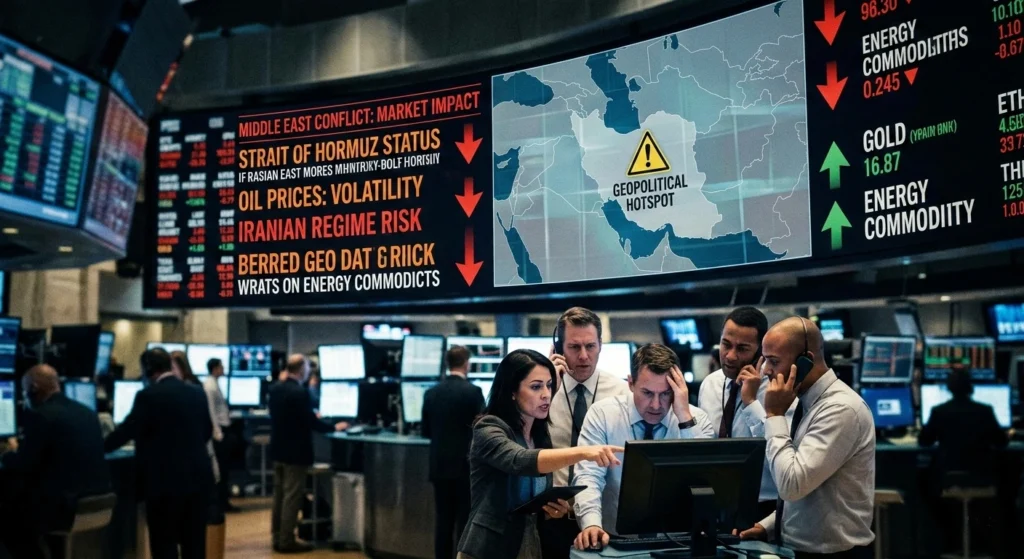
Discover how the Middle East war investors are reacting to the latest global market shocks
The global financial landscape is shifting rapidly today. Markets are now reacting to a massive geopolitical explosion. On Saturday, U.S. and Israeli strikes killed the Iranian Supreme Leader. This event has sent shockwaves across every major trading floor. Consequently, Middle East war investors are now bracing for a long period of instability. This conflict is no longer a small risk. Instead, it has become the primary concern for global capital.
Investors are currently watching Iran very closely. The death of Ayatollah Ali Khamenei has created a power vacuum. Furthermore, the Iranian Revolutionary Guard has already started to retaliate. They have targeted several major cities in the Gulf. As a result, global trade routes are now under direct threat. Airlines have stopped flying over the region immediately. Huge oil tankers have also suspended their travel plans. The world is watching the Strait of Hormuz with deep fear. This narrow waterway is vital for the global economy.
1. The Strategic Impact on Middle East War Investors
The first major risk involves the closure of the Strait of Hormuz. Iran announced that this waterway is no longer safe for ships. Therefore, the Middle East war investors must prepare for massive supply chain breaks. This strait handles a huge portion of the world’s oil. If it stays closed, energy prices will skyrocket globally.
South Korea is already feeling the pressure from this crisis. They import nearly 70 percent of their crude from the Middle East. Almost all of that oil passes through the closed strait. Consequently, Korean energy companies have declared a state of emergency. They are holding urgent meetings to manage their remaining stockpiles. Meanwhile, shipping costs are expected to rise by 80 percent soon. Small exporters will likely suffer the most from these added costs.
2. How Middle East War Investors View Regime Risk
Previously, many experts viewed this conflict as a temporary shock. However, that perspective changed overnight with the latest strikes. The focus has moved from simple retaliation to total regime risk. Middle East war investors are now comparing this to the 1979 revolution. A complete change in the Iranian government could take years. This uncertainty makes it very hard to price assets correctly.
Rong Ren Goh is a portfolio manager at Eastspring Investments. He believes that markets will now reprice for a prolonged conflict. Unless Iran chooses to negotiate, the chaos will continue. Markets usually dislike uncertainty more than bad news itself. Therefore, we are seeing a flight to safe assets. People are moving their money into gold and government bonds. They want to protect their wealth from sudden market drops.
3. Rising Commodity Prices Affecting Middle East War Investors
Energy markets are currently in a state of high alert. Brent crude oil has already risen by 20 percent this year. It is now trading at roughly $73 per barrel. This price could go much higher if the blockade lasts. Middle East war investors are worried about a new wave of inflation. High energy costs usually lead to higher prices for everything else.
Gold has also seen a massive surge in its value. It is up by 22 percent so far in 2026. Investors use gold as a hedge against geopolitical disasters. When wars break out, gold typically becomes more valuable. In addition, the policies of President Donald Trump are adding more variables. His erratic trade decisions often create extra market volatility. Therefore, the combination of war and politics is very dangerous.
For more details on this topic read our earlier coverage here.
4. Logistics and Trade Hurdles for Middle East War Investors
The logistics industry is facing a nightmare scenario right now. Many tankers are simply sitting still in the open sea. They are waiting for news about safe passage through the region. Consequently, the delivery of essential goods is being delayed. This delay will eventually hit the pockets of every consumer. Middle East war investors in the shipping sector are especially worried.
- Airlines have cancelled hundreds of flights across the Middle East.
- Insurance costs for sea vessels have climbed significantly.
- Global shipping routes are being rerouted around Africa.
- These longer routes add days to every delivery schedule.
- Fuel consumption for these ships is also increasing fast.
Furthermore, the European Union Naval Force is monitoring the situation. They reported that many ships cannot pass through the waterway. This creates a bottleneck that affects global manufacturing. If parts do not arrive on time, factories must stop. This ripple effect can cause a global economic slowdown. Therefore, the stakes have never been higher for the world.
5. Future Projections for Middle East War Investors
What does the future hold for the global markets? Most analysts expect the volatility to remain quite high. The complexity of the Iranian ruling system makes it unpredictable. The Revolutionary Guard holds a lot of power in the country. They may choose to keep the conflict going for a long time. Meanwhile, the U.S. and Israel remain on high military alert.
Investors should look for signs of a possible negotiation. If Iran shows a desire to talk, markets might stabilize. However, a full-scale regional war seems more likely right now. This would mean even higher prices for oil and gold. It would also lead to a weaker global stock market. Consequently, Middle East war investors need to be very cautious. They must diversify their portfolios to survive this storm.
- Watch for any official statements from the Iranian leadership.
- Monitor the daily price of Brent crude oil closely.
- Track the movements of the U.S. Navy in the Gulf.
- Keep an eye on global inflation data in the coming weeks.
- Evaluate the performance of defensive stocks like utilities.
In conclusion, the situation in the Middle East is critical. The death of a leader has changed the game for everyone. Markets are no longer ignoring the risks of a big war. Instead, they are pricing in a very dark future. Middle East war investors must act with intelligence and speed. The world economy depends on how this crisis is resolved. We will continue to provide updates as the situation evolves.
For more information, you can read the original report on Reuters.