
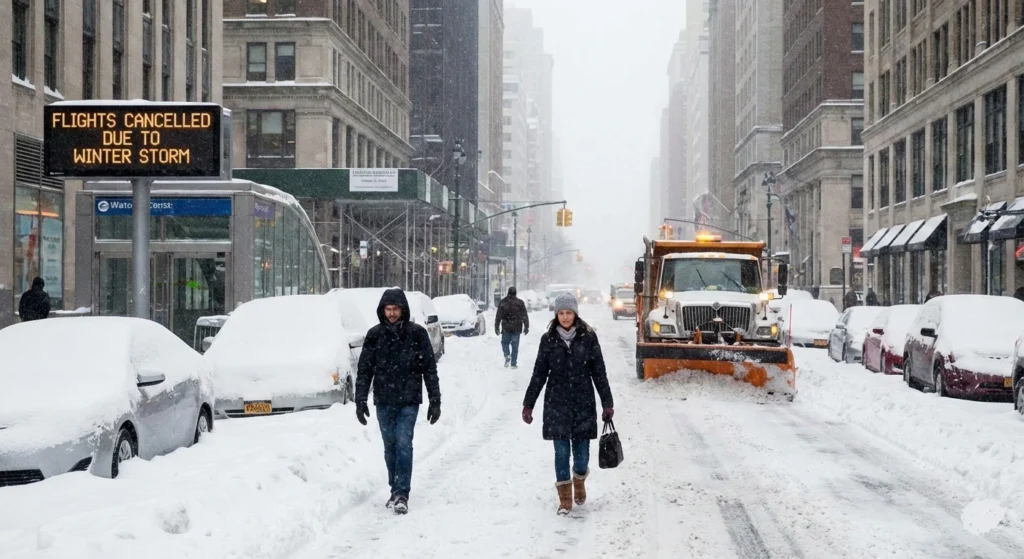
Stay updated on the historic impacts of the current US East Coast snowstorm
A massive winter weather event recently battered the Atlantic seaboard. This US East Coast snowstorm brought record-breaking snowfall to several states on Monday. Consequently, millions of residents faced major disruptions in their daily lives. The storm caused thousands of flight cancellations across the country. Additionally, heavy snow forced city leaders to implement strict travel bans.
The National Weather Service (NWS) tracked the storm from North Carolina to Maine. Specifically, parts of New England saw the highest snow totals in history. For instance, Rhode Island and Massachusetts experienced nearly 37 inches of snow. Meanwhile, New York City dealt with over 19 inches in Central Park. Therefore, this event qualifies as one of the most significant storms in recent years.
Record Snowfall During the US East Coast snowstorm
Rhode Island appeared to suffer the most from the heavy precipitation. In fact, local media reports call this the worst snowstorm in state history. The state capital, Providence, received a staggering 36 inches of snow. This total easily beat the previous record from February 1978. During that year, the city saw 28.6 inches of snow.
Meteorologists in Boston expressed their genuine surprise at these high numbers. They noted that the storm completely smashed existing weather records. Because of the heavy accumulation, travel became nearly impossible in the state. Consequently, officials enforced a ban on all non-essential travel. This move aimed to keep citizens safe during the peak of the blizzard.
- Providence received 36 inches of snow.
- The previous 1978 record was 28.6 inches.
- Rhode Island enforced a strict travel ban.
- Snow totals reached 37 inches in some spots.
Flight Chaos Caused by the US East Coast snowstorm
Travel within and out of the United States faced severe hurdles. According to flight trackers, over 5,700 flights were cancelled on Monday. This US East Coast snowstorm particularly impacted major aviation hubs. Specifically, LaGuardia airport saw 98% of its flights cancelled. Furthermore, JFK airport cancelled 91% of its scheduled departures.
These two airports typically serve over 335,000 passengers every day. However, the heavy snow made runways too dangerous for use. Other cities like Boston, Newark, and Philadelphia faced similar issues. Thousands of travelers remained stranded in terminals across the region. Moreover, the cancellations continued well into Tuesday morning.
- More than 5,706 flights were cancelled on Monday.
- LaGuardia airport stopped 98% of its flights.
- JFK airport cancelled 91% of its operations.
- Over 2,000 more flights were cut on Tuesday.
Power Outages From the US East Coast snowstorm
The heavy, wet snow caused significant damage to infrastructure. Consequently, more than 600,000 properties lost electricity during the storm. Massachusetts faced the most severe power grid failures. Specifically, nearly 300,000 customers in that state sat in the dark. In Barnstable County, roughly 85% of people lost power.
Strong winds accompanied the US East Coast snowstorm, knocking down trees. These falling branches snapped power lines and blocked residential roads. Therefore, utility crews struggled to reach damaged areas quickly. Residents in Connecticut and New Jersey also reported widespread outages. Many families had to rely on generators or wood stoves for heat.
- 600,000 properties lost power along the coast.
- 300,000 Massachusetts residents had no electricity.
- Barnstable County saw an 85% outage rate.
- Downed trees created dangerous road conditions.
Safety Tips for the US East Coast snowstorm
Governors across the region urged residents to remain indoors. Massachusetts Governor Maura Healey warned about extremely dangerous white-out conditions. A white-out occurs when blowing snow reduces visibility to zero. If drivers get stuck, emergency teams cannot reach them easily. Therefore, staying off the roads remains the best safety practice.
In New York City, a travel ban paused the entire metropolis. All bridges, highways, and local roads remained closed for several hours. This ban affected more than eight million people. However, officials lifted the ban once the heaviest snow passed. Even so, the police department investigated several incidents of public misconduct. Specifically, some individuals threw snowballs at officers in Washington Square Park.
- Stay off the roads during travel bans.
- Prepare for zero visibility in white-out conditions.
- Keep emergency kits ready in your home.
- Avoid parking on designated snow emergency routes.
The Historic Impact on Local Media
The storm even affected the historic printing of newspapers. The Boston Globe did not go to print on Monday. This was a first in its 153-year history. Despite surviving pandemics and past blizzards, this storm was too strong. More than two feet of snow blocked the printing press. Consequently, staff members could not reach the facility.
Subscribers had to wait for their physical news updates. The paper decided to deliver two editions together on Wednesday. This event highlights the sheer power of the weather. Even the most resilient businesses had to stop operations. Meanwhile, digital news continued to provide updates to the public.
Understanding the Bomb Cyclone
Meteorologists referred to this event as a “bomb cyclone.” This term describes a rapid drop in atmospheric pressure. This process brings very strong winds and heavy precipitation. Besides the snow, the wind created massive drifts. These drifts covered front doors in Long Island. Some residents could not even exit their homes.
One resident, Sandra Wu, shared her difficult experience. She said her husband tried to dig them out early. However, the falling snow made his efforts feel pointless. She noted that she had never seen a storm this bad. The storm has now moved toward eastern Canada. However, the effects remain visible across the United States.
The Alberta Clipper and Future Forecasts
While the main storm is leaving, more weather is coming. A fast-moving system called an Alberta Clipper is approaching. This will bring more snow and ice to the Great Lakes. Additionally, the North-east will see more high winds on Wednesday. Consequently, the cleanup process may take much longer than expected.
The National Weather Service expects freezing temperatures all week. Frosty nights will make the fallen snow turn into ice. Therefore, walking and driving will remain hazardous for days. Residents should continue to monitor local weather reports carefully. You can find more official updates on the National Weather Service website.
Public Reaction to the Blizzard
The storm turned many residents into “prisoners” in their homes. One Boston resident, Bradley Jay, spoke to news agencies. He felt he could not walk around town for days. The high snow piles block most sidewalks and paths. This creates a sense of isolation for many people.
Despite the hardships, many neighbors helped each other. People used shovels and blowers to clear shared paths. However, the sheer volume of snow remains a massive challenge. Most cities will need a week to clear every street. Until then, life on the East Coast remains at a slow crawl.
Conclusion of the Winter Event
The US East Coast snowstorm has left a lasting mark. It broke records that stood for over forty years. It grounded thousands of planes and cut power to many. However, the region is now beginning the long recovery process. Officials remind everyone to stay patient during snow removal.
The combination of a bomb cyclone and record snow is rare. This event will likely be studied by experts for years. For now, the focus is on restoring power and safety. Stay warm and stay safe as the winter continues.