
US assault Iran campaign reaches a critical turning point as military objectives are met ahead of schedule
The US assault Iran military operation, known as Operation Epic Fury, is moving much faster than expected. Admiral Brad Cooper, the top commander for the Middle East, confirmed this on March 4, 2026. He noted that the initial bombardment was massive. In fact, it was nearly double the size of the 2003 Iraq War.
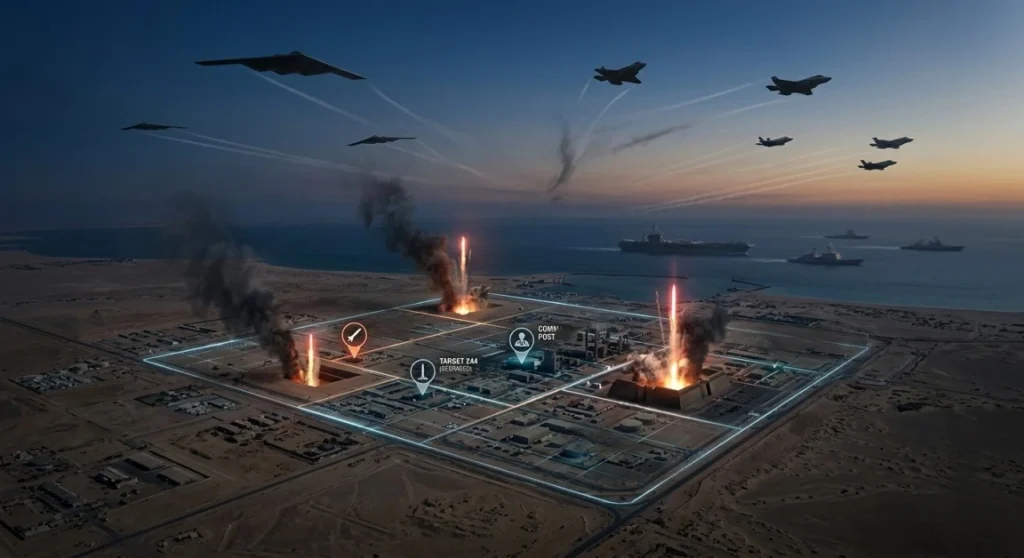
The campaign focuses on degrading the Iranian regime’s ability to strike back. Currently, the US and Israel are targeting sites deep inside the country. These targets include air defense systems, missile launch sites, and command centers. The rapid pace of the operation has caught many people by surprise.
For more details on this topic read our earlier coverage here.
The Rapid Progress of the US assault Iran
The military has reached several critical goals faster than the original plan. Admiral Cooper stated that Iran’s air defenses have been badly degraded. This allows US and Israeli jets to fly with much more freedom. The mission is moving at a lightning pace.
- Over 2,000 Iranian targets were struck in the first 100 hours.
- The Iranian navy has almost no operational vessels left.
- At least 17 Iranian ships have been sunk by US forces so far.
- Strategic command centers in Tehran were hit by very precise strikes.
The US assault Iran strategy is very simple. The military wants to “shoot things that can shoot us.” This direct approach has limited the regime’s capacity to protect its borders. Consequently, the official assessment shows the US is “ahead of the game plan.”
Global Markets Shaken by US assault Iran
The five-day-old war is causing massive waves in the global economy. As the US assault Iran continues, oil prices have surged toward $200 per barrel. This is because Iran has effectively threatened the Strait of Hormuz.
- Airline industries have canceled more than 20,000 flights globally.
- Tourism in the Middle East has come to a total standstill.
- Safe-haven assets like gold and the US dollar are climbing fast.
- Energy production in Qatar and Iraq has faced major interruptions.
The closure of the Strait of Hormuz is a major problem for everyone. About 20% of the world’s petroleum flows through this narrow waterway. President Trump said the US Navy might start escorting oil tankers soon. This move aims to protect global energy supplies from further shocks.
High Intensity Strikes Define the US assault Iran
The scale of this conflict is massive compared to recent modern wars. Admiral Cooper highlighted that 50,000 US troops are currently engaged. They are using 200 jets and two aircraft carriers for the operation.
- Strikes are happening from “seabed to space” including cyberspace.
- B-2 bombers have flown 37-hour round trips to hit deep bunkers.
- Israeli F-35s have recorded air-to-air kills against Iranian jets.
- More than 4,000 bombs have been dropped on military sites already.
The US assault Iran involves cutting-edge technology to blind the enemy. Cyber warfare has disrupted Iranian communications in many cities. This leaves the regime unable to coordinate its defense effectively. Tehran has become a “ghost town” as residents flee the heavy bombing. The precision of these strikes is unlike anything seen before.
Future Outlook for the US assault Iran Campaign
Despite the rapid progress, the Trump administration warns of more risks. Six American soldiers have been confirmed as killed in action so far. Defense Secretary Pete Hegseth stated the US is “accelerating, not decelerating.”
- The operation was initially projected to last for several weeks.
- Trump has not ruled out using ground forces if they are needed.
- Israel aims to stop Iran from producing weapons-grade uranium.
- Regional allies are monitoring their airspace very closely right now.
The US assault Iran remains a fluid situation with very high stakes. While the military is ahead of schedule, the final outcome is not yet clear. Many are watching to see if a new leadership will emerge in Tehran soon. The international community is divided on the long-term impact of this conflict.
Strategic Impact on Regional Security
The campaign is changing the map of the Middle East rapidly. Military experts suggest that Iran’s proxy network is also under heavy pressure. Groups in Lebanon and Yemen have seen their supply lines cut off.
- Hezbollah’s communication with Tehran has been severely limited.
- Houthi rebels are facing increased surveillance from US drones.
- Iranian influence in Iraq is declining as the central government stays neutral.
- The US is building a new security framework with its local partners.
The US assault Iran is not just about a single country. It is about shifting the power balance in the entire region. By removing Iran’s offensive capabilities, the US hopes to bring long-term stability. However, the path to peace is still filled with many challenges.
Economic Resilience Amidst the Conflict
Governments around the world are trying to stabilize their economies. The sudden rise in oil prices has caused inflation to spike in many nations. Central banks are meeting daily to discuss interest rate changes.
- The US Treasury is releasing millions of barrels from strategic reserves.
- European nations are looking for alternative energy sources quickly.
- Solar and wind energy stocks have seen a sudden boost in interest.
- Transportation costs for shipping companies have doubled in a week.
The US assault Iran has shown how interconnected the modern world is. A conflict in one area can affect prices in a small town thousands of miles away. People are bracing for a difficult economic period as the war continues. Yet, there is hope that the rapid military progress will lead to a quick resolution.
For more information on global security developments, visit the Reuters News Service for live updates.