
Stay informed on the latest Iran Middle East attacks and the global response to this escalating regional crisis
The landscape of the Gulf has shifted overnight. A series of massive Iran Middle East attacks has struck multiple nations. These strikes come in response to the death of Supreme Leader Ayatollah Ali Khamenei. US and Israeli air strikes targeted Iran on Saturday morning. Since then, the region has faced intense instability.
UK Defence Secretary John Healey has voiced his primary concern. He aims to protect British military and civilians from these “indiscriminate attacks.” Healey spoke about the gravity of the situation in a recent briefing. He noted that the Iranian regime is acting in an uncontrolled manner.
UK Personnel Targeted in Iran Middle East Attacks
During a recent briefing, John Healey highlighted the immediate dangers. He stated that 300 British personnel were at a base in Bahrain. Some were within several hundred yards of a missile strike on Saturday. This strike was part of a broader retaliatory effort by Iranian forces.
Furthermore, two ballistic missiles were fired toward Cyprus. Officials do not believe Cyprus was the intended target. However, the proximity of these strikes shows the widening scope of the conflict. The UK government is now reviewing the terror threat level at home.
Shadow Foreign Secretary Dame Priti Patel also voiced her concerns. She welcomed the initial US-Israeli strikes on the Iranian regime. However, she criticized the UK’s current proactive stance. She called the lack of action from Sir Keir Starmer “absolutely astonishing.” Patel believes the UK must do more to protect its interests.
Global Travel Disrupted by Iran Middle East Attacks
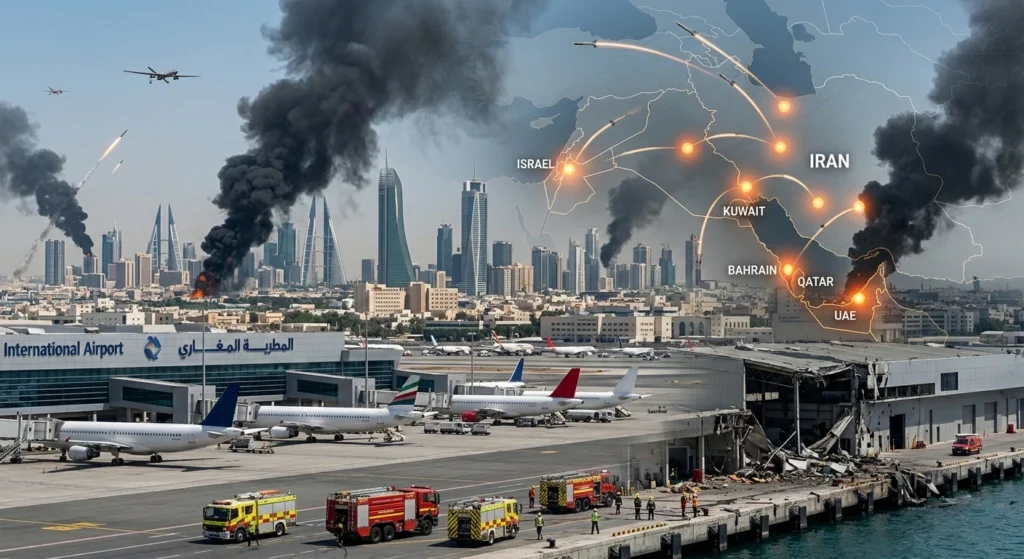
The impact on international travel has been severe. One person died and 11 were injured at major airports. Drones targeted Zayed International Airport (AUH) in Abu Dhabi. Falling debris from an interception caused the casualties there.
Dubai International Airport (DXB) also suffered damage. It is the busiest airport in the world for passenger traffic. Four staff members were injured during the incident. Consequently, thousands of flights are now grounded. This is the worst travel disruption since the International Air Transport Association began monitoring modern regional conflicts.
- Zayed International Airport: 1 dead, 7 injured.
- Dubai International Airport: 4 staff members injured.
- Jebel Ali Port: Fire caused by aerial interception.
- Fairmont The Palm: Explosion and fire reported.
For more details on this topic, read our earlier coverage here.
Widespread Strikes Across the Gulf
Iran has launched waves of attacks against several countries. These include Israel, Bahrain, Qatar, the UAE, Kuwait, and Iraq. The Islamic Revolutionary Guard Corps (IRGC) claimed responsibility for many strikes. They specifically targeted the US Navy’s Fifth Fleet headquarters in Manama.
Huge plumes of smoke rose over the Bahraini capital. Meanwhile, in Oman, drones hit the Duqm commercial port. One worker was injured in that attack. Many US allies in the region have intercepted incoming fire. However, the falling debris continues to cause significant damage.
The Impact of Iran Middle East Attacks on Tourism
Luxury landmarks have not been spared in this conflict. On the Palm Jumeirah in Dubai, a large explosion hit the Fairmont hotel. Video footage shows black smoke rising from the five-star resort. The iconic Burj Al Arab also faced a minor fire. This was caused by debris from an intercepted drone.
The hospitality sector in the UAE is facing a sudden crisis. These Iran Middle East attacks have turned holiday hotspots into danger zones. Many tourists are now seeking ways to leave the region. However, grounded flights make departures nearly impossible at this time.
Political Reactions to the Escalation
Shadow Foreign Secretary Dame Priti Patel commented on the situation. She welcomed the US-Israeli strikes on Iran. However, she criticized the UK government’s stance. Patel called it “astonishing” that Sir Keir Starmer was not more proactive.
The UK did not join the initial US-Israeli air offensive. Instead, the government is focusing on de-escalation. British planes were in the air throughout Saturday night. Their mission is to prevent the conflict from spreading further. Healey insists that “no-one will mourn” the fallen Supreme Leader.
- US and Israel: Launched initial air strikes.
- UK: Providing air support to prevent escalation.
- Iran: Launching retaliatory drone and missile waves.
- Gulf Nations: Intercepting missiles and assessing damage.
Escalation Continues into Sunday
Explosions were heard again on Sunday morning. Cities like Doha, Dubai, and Manama remain on high alert. Iran continues to use ballistic missiles against US assets. The situation is described as “indiscriminate and widespread.”
The UK government remains in close contact with regional partners. They are monitoring the safety of all British citizens. The “uncontrolled” nature of these Iran Middle East attacks is a major worry. Security experts warn that the cycle of retaliation may not end soon.
Security Measures and Future Outlook
The global community is calling for restraint. However, the IRGC shows no signs of stopping. They view these strikes as a necessary response to their leader’s death. The US and Israel have not yet halted their offensive operations.
For the UK, the focus remains on regional stability. John Healey emphasized that protecting lives is the top priority. The review of the domestic terror threat is a precaution. This reflects the unpredictable nature of the current Iranian leadership.
The PBS News Special Report provides real-time updates on these developing military movements. These experts suggest that the situation could evolve rapidly over the next few days.
Summary of Recent Events
- Supreme Leader Khamenei killed in air strikes.
- Iran retaliates with massive missile and drone waves.
- UK troops in Bahrain narrowly miss missile strikes.
- Dubai and Abu Dhabi airports suffer damage and casualties.
- Major disruption to global travel and trade routes.
The coming days will be critical for the Middle East. Whether diplomacy can prevail over missiles remains to be seen. For now, the world remains on edge. The Iran Middle East attacks have changed the regional landscape overnight.